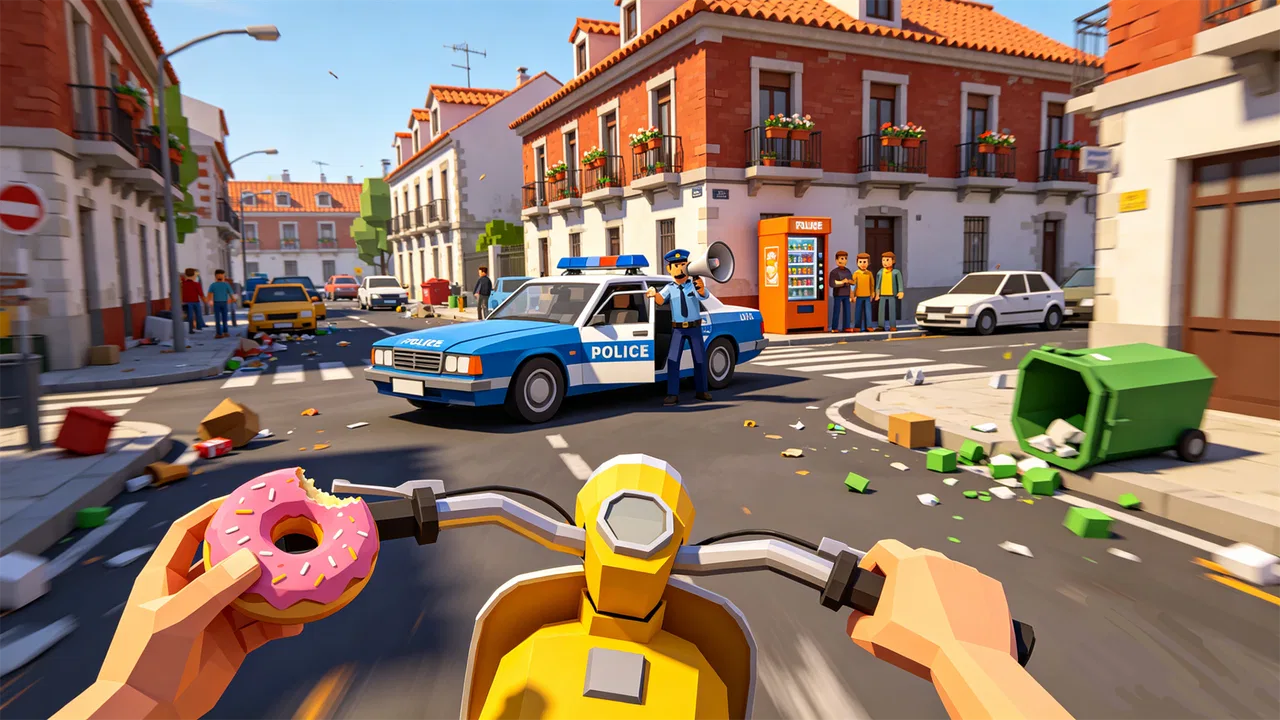
Urban Raid Ops
- 2.9
- Rating
- 500.00K
- Installs
- Free
- Price

 Analysis by App-foxy
Urban Raid Ops is a free role-playing game from Megas Game Studio that puts its focus on a simple promise: move through an urban setting, deal with danger, and stay alive long enough to keep exploring. I approached it as the kind of game I might install for short sessions rather than as a huge, story-heavy adventure, and that expectation matters. Its appeal is tied to quick access and a survival-minded atmosphere, while its modest reception suggests that it will not satisfy every player looking for a polished, deep RPG.
The game is available for everyone and runs on Android devices using version 6.0 or later. It has passed the hundred-thousand-install mark, so it is not an unknown experiment with no audience at all. At the same time, its average rating sits at 2.8 from roughly three hundred ratings, with only a small group of written reviews. I would read that combination as a reason to approach it with curiosity rather than certainty: there is enough interest to justify trying it, but not enough consensus for me to recommend it blindly to every role-playing fan.
How Urban Raid Ops Feels in Actual Use
I’d use this section to set a practical expectation before you begin: the game’s compact urban-raid premise is easier to assess through a few deliberate attempts than through a quick glance at its opening. I’d pay attention to whether its pace feels engaging on your phone and whether learning by trying suits you; that first impression makes the setup and early play much less daunting.
You May Also Like

 Blood Strike: 2.5 Anniversary
Blood Strike’s Loadouts Turn Every Drop Into a Tactical Gamble
A close look at Blood Strike’s custom loadouts: how fast access to signature weapons reshapes its battle royale rhythm, rewards preparation, and narrows the gap between fights.

 Pandora - Music & Podcasts
Pandora’s Music Is Easy to Start, but Harder to Recover
Pandora’s strength is its low-effort path from a seed to a station. Its weak spot is how much confidence it asks you to place in connection, setup, and quiet recovery.

 8 Ball Pool
 Is Built on Rivalries, Rematches, and Routine
A close look at the rivalries, rematches, shared routines, and unanswered safety questions that turn a quick pool match into a persistent mobile community.

 Samsung Music
’s Quiet Strength Is Playing What You Already Own
Its reach comes less from spectacle than from dependable access to a personal library. That simplicity is both the app’s strongest retention engine and its ceiling.

 AccuWeather: Weather Radar
AccuWeather Review: A Quick, Clear Forecast for Everyday Decisions
For everyday plans, the best forecast is the one you can understand quickly. AccuWeather makes rain timing, radar, and local conditions easy to act on, with a few trade-offs.

 Hill Climb Racing
Why Hill Climb Racing Still Turns Crashes Into One More Run
A tiny car, a bumpy hill and one more upgrade: Hill Climb Racing keeps resurfacing because its simple chaos makes every near-miss feel personal.
More From Our News Desk
View All News


Speed expectations before you start
The first thing I would keep in mind is that this is not the sort of title I would choose when I want an expansive, carefully paced console-style RPG. The store summary, “Fight, Explore, Survive,” points toward a direct loop, and the short description, “Urban Raid Ops,” gives the setting more attention than a long explanation of systems. That makes the game easier to understand quickly, but it also means I would not install it expecting a large world, elaborate character drama, or a long tutorial campaign.
For a mobile game, that straightforward identity can be useful. I can imagine opening it during a commute, a waiting-room break, or a few spare minutes at home and immediately understanding the basic mood. The urban raid theme gives the experience a practical direction: move forward, confront threats, and make it through the situation. Games built around that kind of compact objective can feel faster than role-playing titles that spend a long time introducing lore, menus, and multiple currencies.
My advice is to judge the opening session by how quickly it lets you understand the rhythm rather than by whether it delivers a dramatic first impression. If you enjoy learning a game through repeated attempts, Urban Raid Ops may have a reasonable chance of holding your attention. If you need a strong narrative hook or a highly refined onboarding sequence, the low average rating is a useful warning that the first impression may not be consistently convincing for everyone.
One practical tip is to play the first session when you have enough time to try the same basic activity more than once. A short test can tell you whether the controls and pace suit you, but it may not reveal whether the survival loop feels satisfying after the novelty fades. I would give it a focused trial instead of deciding after a single tap through the opening screens.
What happens during heavier play
The demanding moments in a game like this are not necessarily about long play sessions alone. They arrive when several decisions compete for attention: moving through an unfamiliar area, reacting to enemies, and deciding whether to push onward or protect the progress already made. That is where I would look for the real quality of the design. A basic fight can be enjoyable, but the stronger test is whether exploration and survival create meaningful tension rather than simply slowing the player down.
Urban Raid Ops seems best suited to players who enjoy a compact action loop with role-playing flavor. I would approach each session with a small goal, such as learning a route, testing how aggressively I can advance, or finding out which approach keeps a run stable. That method is more useful than rushing through every encounter. It also helps reveal whether the game rewards careful play or merely asks the player to repeat the same actions.
A non-obvious trade-off here is the relationship between speed and caution. In a survival-oriented urban raid, moving quickly may feel exciting, but a reckless approach can make the game seem unfair if the player has not learned its rhythm. I would deliberately vary my pace: one attempt focused on fast movement, another on observing the environment and choosing safer moments to engage. That comparison can show whether the game has genuine tactical texture or whether the apparent choice is mostly cosmetic.
For everyday use, I can see a simple scenario where the game fits: I have ten minutes before leaving the house, want something more active than a puzzle, and do not want to commit to a long story chapter. I can start a short attempt, concentrate on surviving, and stop when the time is up. The same quality can become a weakness during a long evening, though. If the core loop does not keep changing enough, repeated raids may begin to feel like busywork rather than progress.
Reliability and the question of recovery
Reliability is especially important in a survival game because losing a run feels worse when the interruption comes from the app rather than from a mistake. I would pay attention to whether the game returns me to a sensible point after leaving it, whether a brief phone call disrupts the session, and whether the interface remains understandable when I come back later. Those are the details that determine whether a mobile title works in real life instead of only during an uninterrupted test.
I would not treat a single smooth session as proof that every device will behave identically. Android hardware varies considerably, and the game’s minimum operating-system requirement reaches back to Android 6.0, which makes it accessible to a broad range of phones and tablets. That compatibility is convenient, but it also means players may be using very different processors, memory configurations, and storage conditions. My own recommendation would be to test it on the device you actually plan to use rather than assuming that another player’s experience will transfer perfectly.
Recovery also affects how I would organize play. Before closing the game, I would avoid quitting at the most important moment of a raid and would give the app a moment to finish whatever transition is on screen. That is not a claim about a particular save system; it is simply good practice for any mobile game where progress matters. If you regularly switch between apps, make that part of your early test. A game that feels fine in a continuous session may be less comfortable when used in short, interrupted bursts.
The limited number of written reviews means I would be careful about drawing a broad reliability conclusion from public reactions alone. A rating around 2.8 deserves attention, but it does not explain whether dissatisfaction came from controls, content, performance, difficulty, or individual expectations. I see it as a signal to test the game personally, especially if you are sensitive to crashes, lost progress, or inconsistent behavior.
Device constraints and sensible expectations
The Android 6.0 requirement is one of the clearest practical advantages. Players with an older compatible phone are not automatically excluded, which is helpful for anyone who keeps a secondary device for gaming. Still, an operating-system requirement does not guarantee identical performance across all supported hardware. A newer phone may offer a more comfortable experience simply because it has more headroom for loading and multitasking.
I would prepare the device before judging the game harshly. Closing demanding background apps, leaving adequate storage space, and avoiding play while the phone is already hot can make a meaningful difference to any mobile title. These steps do not transform a poorly optimized game into a fast one, but they reduce outside factors that can make the result confusing. If the game feels unstable only after several demanding apps have been open, I would repeat the test with a cleaner setup before deciding whether the problem is specific to Urban Raid Ops.
Resource demands are also connected to session length. A short raid may feel perfectly manageable, while a longer period of exploration can expose heat, battery drain, or sluggish transitions on weaker hardware. I would therefore test both: one brief session after opening the game and one longer session when the device is not plugged in. That gives a more honest picture of whether it fits your routine.
Players using older devices should also consider screen comfort and control precision. A game that asks for quick reactions can be more tiring on a small or less responsive display, even if the phone technically meets the operating-system requirement. If you normally play RPGs with slower menus and more time to plan, the urban raid framing may feel more demanding than the category label suggests.
Where it stands beside familiar role-playing alternatives
Compared with a traditional story-driven RPG, Urban Raid Ops appears to be the lighter commitment. I would choose it when I want a direct survival-flavored session, not when I want a carefully developed cast, a large quest log, or a long narrative arc. A conventional RPG is likely the better option for someone who measures value by world-building and character progression. Urban Raid Ops makes more sense for a player who values immediacy and does not mind a narrower focus.
It also differs from casual arcade games. The role-playing label suggests that the experience is meant to feel more like an ongoing character-centered challenge than a single reflex test. That can appeal to players who want some sense of development around their action, but it may frustrate people who expect the depth associated with larger mobile RPGs. I would not compare it directly with a content-heavy online game; the expectations are simply too different.
Another useful comparison is with survival games that emphasize crafting, building, or open-ended resource management. If those systems are the main reason you enjoy the genre, you should not assume that the urban raid concept provides the same kind of freedom. Urban Raid Ops should be approached on its own terms: a focused game built around fighting, exploring, and surviving rather than as a replacement for every type of survival RPG.
The strongest alternative for a particular user may be a simpler offline game with a more predictable session structure. If you mainly play while traveling or with limited time, reliability and quick recovery may matter more than atmosphere. On the other hand, if you enjoy testing routes and improving through repetition, this title may offer a more interesting challenge than a purely casual game. The right choice depends less on the label “role-playing” and more on whether its compact raid identity matches your habits.
Who should try it, and who should skip it
I would recommend giving it a chance if you like urban settings, survival pressure, and games that can be explored without a major financial commitment. Since it is free and rated for everyone, the barrier to trying it is low. It could also suit someone with an older Android phone who wants to see whether a smaller role-playing game runs comfortably on available hardware.
I would be more cautious if you want polished presentation, deep storytelling, or a broad selection of systems. The average rating is not strong enough for me to overlook those expectations. Players who dislike repeating encounters, who need highly dependable progress recovery, or who prefer richly explained mechanics may be happier with a more established alternative in the role-playing category.
Families should still consider the individual player’s comfort with combat themes even though the formal age rating is Everyone. The rating makes the game broadly accessible, but age labels do not tell me whether the pace, difficulty, or atmosphere will suit a particular child. I would let younger players try it with guidance and see whether the controls and objectives are clear enough for them.
Small habits that make the trial more useful
I would begin by keeping the first several sessions deliberately experimental. Instead of trying to maximize progress immediately, I would learn how movement, encounters, and exploration fit together. That approach helps separate a genuine design weakness from the normal confusion of learning a new game. It also prevents a bad early decision from shaping my entire opinion of the title.
Second, I would test the game under the conditions in which I actually plan to use it. If I want a commute game, I would try short sessions with interruptions. If I expect longer evening play, I would check how it feels after the initial excitement has passed. This is more valuable than judging it only on a freshly charged phone in a quiet room.
Third, I would keep expectations aligned with the developer’s compact presentation. Megas Game Studio has positioned the title around an urban raid idea rather than a long explanation of an enormous RPG universe. I would treat that restraint as both a strength and a limitation: it makes the game easy to understand, but it leaves less room for players who want layers of story and progression.
Finally, I would use the rating as a prompt for personal testing, not as an automatic rejection. A 2.8 average from around three hundred ratings is a meaningful caution sign, yet individual preferences matter greatly in a focused game. Someone who enjoys short survival challenges may find more value here than someone expecting a premium-scale adventure.
My performance verdict
After weighing the game’s purpose against the practical concerns of mobile play, I see Urban Raid Ops as a low-risk experiment rather than a confident recommendation for every RPG fan. Its free access, broad Android compatibility, and clear fight-explore-survive identity make it easy to try. The hundred-thousand-plus install base shows that people have found it worth downloading, but the modest average rating tells me to keep expectations measured.
For speed, I would expect a direct experience rather than a sprawling one. For heavier use, I would watch whether repeated raids remain engaging and whether the device stays comfortable during longer sessions. For reliability, I would personally test interruptions and recovery early. For hardware, I would remember that Android 6.0 compatibility opens the door to older devices without promising the same results on every phone.
The current version is 207, so anyone installing it should make sure the app completes its normal update process before judging the experience. I would then spend enough time to test both a quick session and a longer one. That simple routine answers the questions that matter most: does it feel responsive on my phone, does it remain enjoyable after the first attempt, and can it fit naturally into the way I play?
My final view is cautiously positive for the right audience. I would recommend Urban Raid Ops to a curious player who wants a free, compact urban survival RPG and is comfortable forming an opinion through hands-on testing. I would skip it in favor of a more established role-playing game if I wanted rich storytelling, extensive progression, or a consistently polished experience from the first minute. Its best quality is its focused premise; its biggest risk is that the focus may not provide enough depth or refinement for long-term players.
FAQs for Urban Raid Ops
01What is Urban Raid Ops?
Urban Raid Ops is an action-packed mobile game available on both Android and iOS devices. It blends strategic planning with fast-paced gameplay, challenging players to complete missions in a futuristic urban environment. The game offers a variety of levels, each with unique objectives and increasing difficulty.
02Is Urban Raid Ops free to play?
Yes, Urban Raid Ops is free to download and play. However, it includes in-app purchases that can enhance the gaming experience by providing additional content, power-ups, and customization options. Players can choose to spend money to progress faster or enjoy the game without any purchases.
03What are the system requirements for Urban Raid Ops?
Urban Raid Ops requires Android 5.0 or later and iOS 11.0 or later. The game is optimized for smooth performance on most modern devices. However, for the best experience, it is recommended to play on a device with at least 2GB of RAM and a stable internet connection.
04Does Urban Raid Ops support multiplayer mode?
Yes, Urban Raid Ops includes a multiplayer mode where players can team up with friends or compete against others worldwide. The multiplayer aspect adds a competitive edge, allowing players to strategize and battle in real-time, enhancing the overall engagement and replayability of the game.
05Are there any parental controls in Urban Raid Ops?
Urban Raid Ops is designed with safety in mind and includes parental control features. Parents can restrict in-app purchases and limit screen time. The game content is suitable for players aged 12 and up, but it is always recommended for parents to review the game and its features to ensure it aligns with their family’s values and expectations.
Pros
- Intuitive controls for smooth gameplay
- Varied mission objectives keep it engaging
- High-quality graphics enhance immersion
- Multiplayer mode for competitive fun
- Regular updates with new content
Cons
- In-app purchases can be pricey
- Occasional lag in multiplayer mode
- Requires a stable internet connection
- Battery drain on older devices
- Limited customization options

Urban Raid Ops
Gallery